
Marble Tabletop Weight Calculator for Project Orders
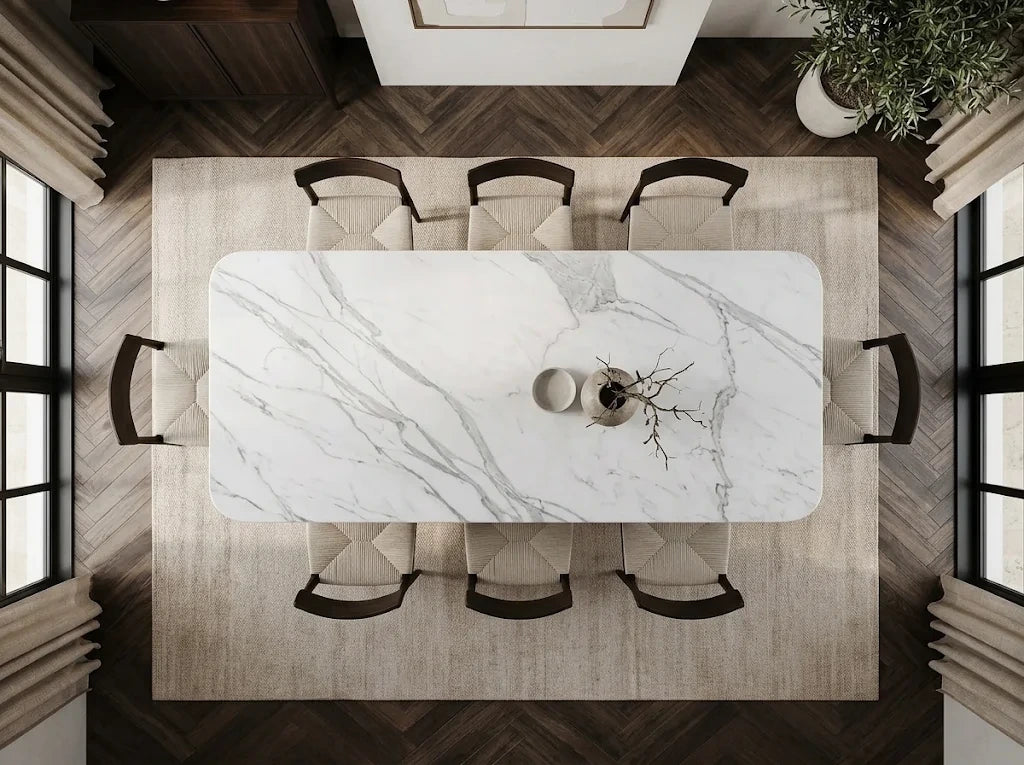
A buyer choosing a 180 × 95 cm marble tabletop may receive two quite different weight estimates. With the same footprint and stone, a solid 20 mm rectangle works out to about 93 kg (205 lb). At 30 mm it is about 139 kg (307 lb). Before comparing freight quotes, ask which thickness the estimate uses and whether it covers the stone, the assembled table or a packed crate.
Use the calculator to compare a custom rectangle or one of the six sizes in the STARMASON DT001 Carrara dining table catalog. The catalog confirms length and width. Both thicknesses below are hypothetical. The 76 cm catalog dimension is the height of the assembled table.
Estimate the stone blank weight
Choose a DT001 catalog footprint or enter your own dimensions. The result covers a solid rectangular stone blank before corner shaping or cut-outs.
Estimated rectangular stone blank
kg lb
180 × 95 cm · 20 mm · 2715 kg/m³
This is a geometry estimate, not a measured tabletop weight. It excludes the base, fixings, backing and packaging, and does not deduct rounded corners or openings. Ask the supplier for finished-piece and packed weights.
Copy a supplier weight-check card
Attach this card to your drawing or purchase-order review. The supplier should fill the measured values; the estimate does not fill them automatically.
How this estimate is calculated
Convert each dimension to metres, multiply length × width × thickness, then multiply by density. One pound equals 0.45359237 kg.
kg = (cm ÷ 100) × (cm ÷ 100) × (mm ÷ 1000) × kg/m³
lb = kg ÷ 0.45359237
How the tabletop estimate works
Multiply length × width × stone thickness, all in metres, then multiply by density in kg/m³. For the smaller example, 1.80 × 0.95 × 0.020 × 2,715 = 92.853 kg. The density comes from the “Weight per unit volume” entry in Marmi di Carrara’s Bianco Carrara C technical data sheet. It is a reference for that stone. Use your supplier’s value for the slab on your order.
Look at the corners in the DT001 plan view above. The catalog length and width enclose a full rectangle, including stone that is cut away at each rounded corner. An apron glued to the underside can also make the edge look much thicker than the stone through the middle. Ask for a section through both the field and edge before entering thickness. For a backed or hollow assembly, request a weight for the fabricated component.
What changes across the six DT001 sizes?
| Catalog footprint | At 20 mm | At 30 mm |
|---|---|---|
| 180 × 95 cm | 93 | 139 |
| 190 × 100 cm | 103 | 155 |
| 200 × 100 cm | 109 | 163 |
| 220 × 100 cm | 119 | 179 |
| 240 × 110 cm | 143 | 215 |
| 270 × 120 cm | 176 | 264 |
At 180 × 95 cm, an extra 10 mm adds roughly 46 kg of stone. At 270 × 120 cm it adds about 88 kg. If two bidders disagree by that much, compare their section drawings before asking either one to revise its freight price.
Which weight belongs on the purchase order?
If the top and two panel supports travel separately, the assembled weight tells the receiving team very little about the heaviest piece it will receive. Copy these six lines into your request and have the supplier identify which figures are estimates and which were weighed. Use preliminary figures to compare quotes, then have the supplier replace them with measured figures on the final packing list before dispatch.
- Drawing revision and construction. Record the footprint, stone thickness through the middle, edge build-up and backing.
- Finished top. Record the calculated stone-only estimate beside the supplier’s weight for the finished top, including bonded backing and attached fittings. Keep both figures labelled.
- Supports and hardware. Request each separate component’s weight and identify the heaviest single piece.
- Complete table. Ask for the total net weight of all supplied parts per table, excluding packaging.
- Each crate. Request its ID, contents, outside dimensions and gross weight after packing. Match each crate to the item and quantity on the order.
- Delivery. Give the crate list to the carrier for the freight quote and to the site team to check the receiving route and equipment. Record who confirms access before dispatch.

For a quotation, send the project team your table size, quantity and delivery city. Identify the floor and any goods-lift or doorway limits. For the information to exchange with your forwarder, see the packing and loading notes.