
Honed vs. polished marble for restaurant tables
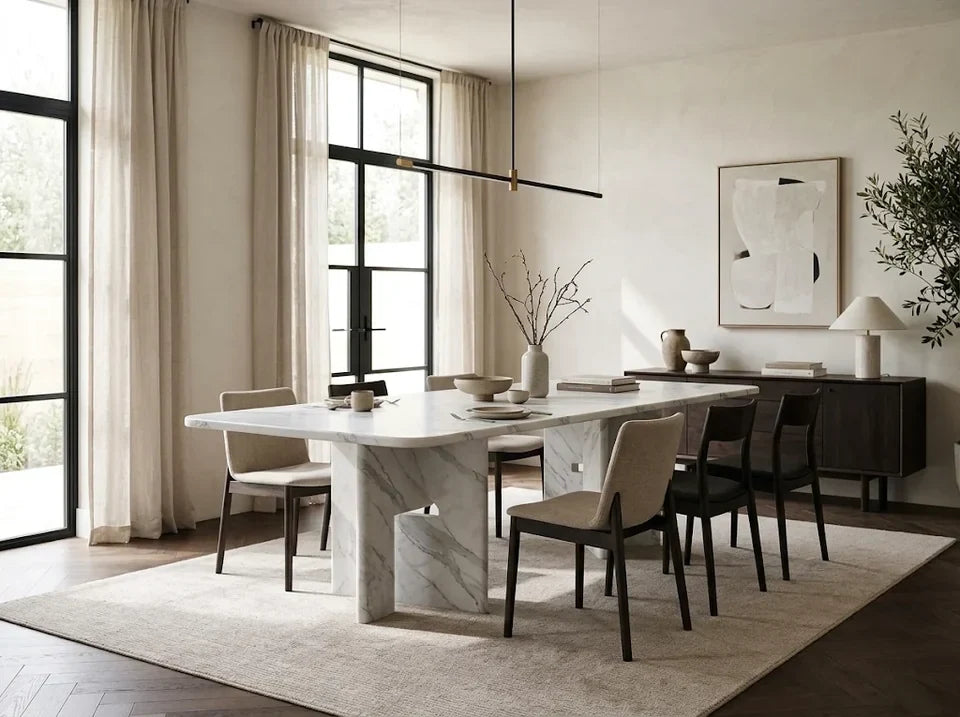
In a dining room with low pendant lights, a polished marble top can reflect the bulb between two place settings. A honed top has a smooth, matte surface that softens that reflection. If the lighting designer wants a clear reflection, start with polished. If the operator wants the table to look quiet beside a bright window, try honed first. Make the final choice with a piece of the proposed stone on a table at dining height.
Look from the guest’s seat
Ask the supplier for two adjacent offcuts from the same slab, if available, one honed and one polished. Comparing two unrelated pieces of Carrara makes it hard to tell whether it is the finish or the veining you prefer. Ask which surface treatment, if any, was used on each.
Lay the dry samples side by side. Sit facing the window, then move to the opposite seat. Switch on the pendants at their evening setting and put a white plate and a water glass on each sample. Look at where the light falls across the plate setting. A finish that looks right held upright in a showroom can look quite different laid flat under a pendant.
What will the table look like after service?
A dull ring and a dark patch call for different decisions. Lemon juice or vinegar can etch marble, changing the way the surface reflects light. A stain changes the color and can occur alongside etching. A penetrating sealer can help resist staining. The marble can still etch. The Natural Stone Institute explains both effects in its sections on sealing and etch marks. Care & Cleaning of Natural Stone
Keep the approval samples clean. Ask for a spare offcut for the restaurant team to try with its usual drinks and stone-compatible cleaning products. Let it dry, then look again from the guest’s seat. A change in sheen can stand out on a polished surface under a pendant. On honed stone it may catch the eye less readily, depending on the stone and the light. Ask the person who clears the tables whether that appearance is acceptable after an ordinary service. The “Acid resistance” section of A Scientific Guide to Shopping for Natural Stone explains how to recognize an etch when comparing samples.
Put the finish decision on the purchase schedule
For example, the DT001 Italian Carrara dining table has a rectangular top on two marble supports. One catalog size is 180 × 95 × 76 cm. The catalog identifies the stone and dimensions. Use the physical sample to settle the sheen and ask for a finished edge on the offcut if the edge will be visible from the seat.
DT001, Italian Carrara, 180 × 95 × 76 cm. Please confirm whether you can provide matching honed and polished offcuts with the proposed table edge. Identify any treatment and give each sample a reference we can put on the drawing.
When the designer and restaurant operator agree on a sample, record its reference and finish on the furniture schedule and keep the approved piece for comparison. The finish approval guide covers what to record before fabrication.
Request a finish sample for DT001
Still choosing the stone? Compare travertine and marble dining tables.